


Traditional Scottish Clothing: From Highland Dress to Modern Wear
by Teresa Finn on Sep 04, 2026
Table of Content
Traditional Scottish clothing is closely associated with Highland dress, a distinctive style built around tartan, kilts, and traditional accessories such as the sporran, kilt hose, and Highland jackets. While the kilt is its most recognizable piece, Scottish dress also includes historic garments for both men and women, from trews and the Great Kilt to the arisaid.
Today, people still wear Highland dress at weddings, Highland Games, ceilidhs, clan gatherings, and other cultural occasions. This guide explores the key garments, their history, and how they come together in traditional Scottish attire.
Traditional Scottish Clothing at a Glance
Traditional Scottish attire combines distinctive garments, accessories, footwear, and headwear, with different pieces worn depending on the occasion and level of formality.
Clothing Item |
Category |
Traditionally Worn By |
Purpose |
Kilt |
Main Garment |
Traditionally Men |
Core garment of Highland dress, also worn by women today |
Trews |
Main Garment |
Men |
Tartan trousers traditionally worn as an alternative to the kilt |
Arisaid (Earasaid) |
Main Garment |
Women |
Historic draped garment worn by Highland women |
Kilted Skirt |
Main Garment |
Women |
Women's tailored garment inspired by traditional kilt construction |
Argyll Jacket |
Outerwear |
Men |
Versatile Highland jacket for day and semi-formal wear |
Prince Charlie Jacket |
Outerwear |
Men |
Formal evening Highland wear |
Waistcoat |
Layering Piece |
Men |
Adds structure and formality to a Highland outfit |
Sporran |
Accessory |
Men |
Functional pouch worn at the front of a kilt |
Fly Plaid |
Accessory |
Men |
Tartan shoulder plaid typically associated with formal Highland dress |
Tartan Sash |
Accessory |
Women |
Tartan accessory worn over the shoulder for formal or ceremonial occasions |
Kilt Hose & Flashes |
Accessory |
Traditionally Men |
Knee-high hose and decorative garter tabs worn with a kilt |
Ghillie Brogues |
Footwear |
Men & Women |
Traditional lace-up footwear associated with Highland dress |
Balmoral Bonnet |
Headwear |
Traditionally Men |
Traditional Scottish bonnet associated with Highland dress |
Glengarry Bonnet |
Headwear |
Traditionally Men |
Foldable bonnet associated particularly with Scottish military dress |
Sgian-Dubh |
Ceremonial Item |
Traditionally Men |
Small traditional knife worn at the top of the kilt hose |
Not every Highland outfit includes all of these pieces. The combination varies by wearer and occasion, from day dress to weddings and formal Highland events.
The Origins of Traditional Scottish Clothing

What Did Scots Wear Before Kilts?
Before the kilt became associated with Highland dress, clothing in Scotland varied by period, region, social status, and cultural tradition. In Gaelic-speaking areas, men could wear a léine, a long linen shirt or tunic, with woolen outer garments for warmth. Cloaks or plaids could be wrapped around the body, while hose and forms of trews were also part of earlier dress traditions.
No single outfit was worn across Scotland. Highland and Lowland clothing developed differently and was also influenced by fashions elsewhere in Britain and Europe. This wider context is important because what we now call traditional Scottish clothing largely reflects the evolution of Highland dress, rather than every form of clothing historically worn in Scotland.
From the Great Kilt to the Modern Kilt
One of the most important developments in Highland dress was the Great Kilt, or fèileadh mòr (belted plaid). Made from a large length of woolen cloth, it could be gathered and belted around the body, with the remaining fabric arranged over the upper body or shoulder.
Over time, the more compact small kilt, or fèileadh beag, became established. Unlike the voluminous belted plaid, it covered the lower body and eventually developed into the structured, tailored kilt familiar today. By the late 18th and early 19th centuries, Highland outfits worn by Scottish gentlemen were becoming increasingly tailored, while jackets, waistcoats, hose, brogues, and other accessories contributed to a more standardized style of Highland dress.

The Dress Act, Tartan Revival, and Highland Identity
Highland dress also carries a complicated political history. After the Jacobite Rising of 1745–46, legislation that took effect in 1747 restricted civilian men and boys from wearing specified forms of Highland clothing, including the plaid, little kilt, trews, and certain tartan outer garments. Women and soldiers serving in the British Army were exempt, and Highland dress continued within Scottish military regiments. The restrictions were repealed in 1782.
During the late 18th and 19th centuries, Highland dress underwent a major cultural revival. Romantic interest in the Highlands, Highland clubs and societies, military traditions, and events such as King George IV's 1822 visit to Edinburgh helped bring tartan and Highland dress to a much wider audience. As tailoring became more standardized, clan tartans, badges, and other identifying details also became increasingly prominent.
The result was a living dress tradition that continued to evolve rather than a costume frozen in one historical period. Many of the garments now associated with traditional Scottish clothing grew from this Highland tradition and remain part of Scottish traditional and ceremonial dress today.
Traditional Scottish Clothing for Men
Traditional Scottish clothing for men is most closely associated with Highland dress, typically built around a kilt or trews and completed with a suitable jacket, kilt hose, footwear, and accessories. The exact combination depends on the occasion and level of formality.
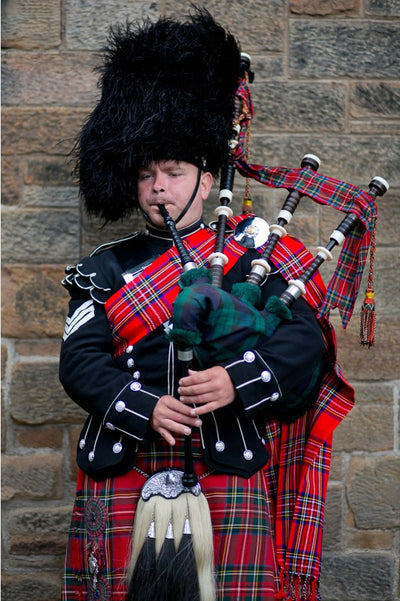
The Kilt
The kilt is the most recognizable garment in traditional Scottish Highland dress. It is a tailored, wraparound garment traditionally made from wool, with overlapping aprons at the front and pleats at the back. Many modern kilts are made in tartan, although tartan itself is a textile pattern rather than a type of garment.
Today, the kilt remains central to both traditional and contemporary Highland dress. The rest of the outfit changes with the setting so that the same kilt can be part of either relaxed daywear or more formal attire.
Trews
Trews are close-fitting trousers historically associated with Highland dress, often made from tartan cloth. They provide a traditional alternative to the kilt and have long been associated with both civilian and military dress.
Modern trews can be paired with Highland jackets and other coordinating pieces for weddings, formal occasions, or contemporary Scottish outfits. Unlike a kilt, they cover the full leg, making them a practical option when you prefer trousers.

Feature |
Kilt |
Trews |
Style |
Pleated wraparound garment |
Tailored trousers |
Length |
Around the knee |
Full length |
Typical Fabric |
Often tartan wool |
Often tartan wool |
Modern Use |
Day, ceremonial, and formal Highland dress |
Alternative Highland and formal wear |
Highland Jackets
A Highland jacket sets the formality level for a traditional Scottish outfit. Two of the most familiar styles are the Argyll jacket and Prince Charlie jacket.
The Argyll jacket is a versatile choice for day dress, weddings, and many semi-formal occasions. Its relatively understated design suits a range of Highland outfits.
The Prince Charlie jacket is associated with more formal evening dress. It is typically shorter at the front and worn with a waistcoat as part of a dressier Highland ensemble.
The appropriate jacket depends on the event, so no single jacket fits every traditional Scottish outfit.


Kilt Hose and Flashes
Kilt hose are long socks worn with a kilt, typically reaching just below the knee with the tops turned down to form cuffs. They are an important part of the overall proportions and appearance of Highland dress.
Flashes are small fabric tabs attached to garters worn beneath the turned-down cuffs. They help keep the hose in place while adding a decorative detail. Their colors can complement the tartan or other elements of the outfit without necessarily matching them exactly.

Ghillie Brogues
Ghillie brogues are traditional lace-up shoes commonly associated with Highland dress. Their distinctive design features long laces wrapped around the ankle rather than tied close to the shoe, as with conventional dress shoes.
They are particularly recognizable in formal and ceremonial Highland outfits. However, they are not the only footwear you can wear with a kilt. Depending on the occasion, other suitable brogues or dress shoes may also be appropriate.
Traditional Scottish Clothing for Women
The Arisaid / Earasaid
The arisaid (earasaid) is a historic garment associated with women in the Scottish Highlands. It consisted of a large length of cloth that could be wrapped around the body and arranged over the shoulders, providing both clothing and protection from the weather.
Although it is sometimes described as a female equivalent of the Great Kilt, that comparison can be misleading. The arisaid had its own form and wearing traditions and is better understood as part of historic Highland women’s dress rather than simply as a women’s kilt.

Tartan Sashes
A tartan sash is a length of tartan fabric worn over the shoulder or draped across the upper body. Today, women may wear tartan sashes at weddings, Highland gatherings, formal events, and other occasions that celebrate Scottish heritage.
A sash can feature a tartan connected with a family, clan, district, organization, or another personal association. However, not every tartan represents a clan, and how a sash is worn can vary by event and tradition.

Women's Kilts and Kilted Skirts
Women can and do wear kilts today. Modern women’s versions may be sold as ladies’ kilts, women’s kilts, or kilted skirts. Still, a true kilt is distinguished by its wraparound construction, overlapping aprons, and pleating, not simply by being made from tartan fabric.
This also means that not every tartan skirt is a kilt. A tartan skirt may use the same type of patterned cloth without following traditional kilt construction, while a women’s kilt or kilted skirt is typically tailored with features derived from Highland dress.
Historically, the kilt was primarily associated with men’s Highland dress, while women had different clothing traditions, including the arisaid. Modern practice is much more flexible, and women now wear kilts for Highland dancing, pipe bands, weddings, formal events, and everyday expressions of Scottish heritage.

Modern Scottish Dress for Women
Modern Scottish dress for women combines traditional tartan and Highland influences with contemporary clothing. Depending on the occasion, this may include a tailored kilt or kilted skirt, a tartan dress, a sash, a shawl, or other tartan accessories.
For formal and cultural events, these pieces let women incorporate Scottish heritage without reproducing a historical outfit exactly. Contemporary Scottish dress therefore reflects a continuing tradition: one that draws from historic Highland clothing while adapting its fabrics, silhouettes, and styling for modern wear.
Essential Accessories in Highland Dress
Sporran
The sporran is a pouch worn at the front of the kilt, traditionally suspended from a leather strap or chain around the waist. Because a traditional kilt has no built-in pockets, the sporran provides a practical place to carry small personal items while also serving as a distinctive part of Highland dress.
Different styles suit different occasions. Day sporrans tend to be simpler and are commonly made primarily from leather. In contrast, dress sporrans are more decorative and may incorporate fur, metalwork, or ornate detailing. Semi-dress styles fall between the two, making the sporran an easy way to adjust an outfit's formality.

Sgian-Dubh
The sgian-dubh is a small traditional knife associated with Highland dress. It is conventionally worn tucked into the top of the kilt hose with only the upper part of the handle visible.
Today, the sgian-dubh is primarily a ceremonial element of Highland attire rather than an everyday tool. Because laws, venue policies, and event rules concerning knives vary, wearers should check local requirements; non-bladed replicas are sometimes used where carrying a real blade is inappropriate or prohibited.

Kilt Pin
The kilt pin is a decorative accessory attached near the lower corner of the kilt’s outer apron. Despite its name, it does not fasten the two aprons together or hold the kilt closed.
Instead, the pin adds a decorative finishing detail and a small amount of weight to the outer apron. Attaching it only through the outer layer also helps avoid restricting the kilt's natural movement.
Fly Plaid
A fly plaid is a piece of tartan cloth worn over the shoulder as part of more formal or ceremonial Highland dress. It is typically secured to the jacket at the shoulder with a brooch, allowing the fabric to fall behind the wearer.
Unlike the historic Great Kilt, the modern fly plaid is an accessory rather than the upper portion of the kilt itself. It is most often seen with dressier Highland outfits, including some wedding and ceremonial ensembles. It is optional, not an essential component of every kilt outfit.

Traditional Scottish Headwear and Ceremonial Pieces
Balmoral Bonnet
The Balmoral bonnet is a traditional Scottish wool bonnet with a broad, rounded crown and a close-fitting headband. It is commonly associated with Highland dress and may feature details such as ribbons at the back and a toorie on top.
Depending on the style and context, a Balmoral may also display a clan badge or other insignia. Today, it can be worn with traditional Highland attire for cultural, ceremonial, and formal occasions.
Glengarry
The Glengarry is a narrow, foldable Scottish cap recognized by its creased shape, small toorie, and ribbons at the back. Its compact design distinguishes it from the broader Balmoral bonnet.
The Glengarry became particularly associated with Scottish military dress and remains visible in military, pipe band, and ceremonial settings. It can also be paired with civilian Highland dress, depending on the occasion.

Tam o' Shanter
The Tam o’ Shanter is a broad, flat Scottish bonnet traditionally made from wool. Its name comes from the title character of Robert Burns’s 1790 poem Tam o’ Shanter, although the bonnet style predates the poem.
Often finished with a toorie at the center, the Tam o’ Shanter has become one of Scotland’s most recognizable forms of traditional headwear. It is closely related to Scotland’s broader bonnet tradition rather than being a required component of a formal kilt outfit.

Feather Bonnets and Ceremonial Dress
The feather bonnet is an elaborate form of Scottish military headwear characterized by its tall profile and prominent feather covering. It developed within Highland military dress and became especially associated with Highland regiments and ceremonial uniforms.
Today, feather bonnets are most commonly seen in military ceremonies and some pipe band traditions, rather than ordinary civilian Highland dress. Their specialized role makes them an important part of Scottish ceremonial clothing, but not a standard accessory for a modern kilt outfit.
What Makes a Complete Traditional Scottish Outfit?
A traditional Scottish kilt outfit centers on the kilt, with the jacket, sporran, shirt, hose, footwear, and accessories adapted to the occasion. Highland dress can range from relaxed daywear to formal evening attire.
Dress Level |
Typical Jacket |
Sporran |
Shirt & Neckwear |
Footwear |
Optional Extras |
Day / Casual |
Tweed or casual Highland jacket; sometimes no jacket |
Day sporran |
Casual shirt |
Brogues or leather shoes |
Kilt pin, sgian-dubh |
Semi-Formal |
Argyll jacket |
Day or semi-dress sporran |
Dress shirt with appropriate neckwear |
Brogues or ghillie brogues |
Waistcoat, kilt pin, sgian-dubh |
Formal / Evening |
Prince Charlie or formal Highland jacket |
Dress sporran |
Formal shirt with bow tie or evening neckwear |
Polished brogues or ghillie brogues |
Waistcoat, sgian-dubh, kilt pin, fly plaid |
Day or Casual Highland Dress

Semi-Formal Highland Dress
Formal and Evening Highland Dress
What to Wear to a Scottish Wedding
For a Scottish wedding, the right kilt outfit depends on the dress code, venue, time of day, and your role in the celebration. An Argyll jacket works for many daytime or semi-formal weddings, while more formal Highland jackets may suit evening events. A clan tartan can be meaningful, but it isn't required—the overall outfit should match the occasion's formality.
Traditional Highland dress continues to evolve alongside modern Scottish clothing. Today, tartan and kilt-inspired designs also appear in contemporary skirts, dresses, jackets, and accessories, allowing elements of Scottish dress to move between cultural tradition and modern fashion.

Common Misconceptions About Scottish Clothing
Traditional Scottish clothing is often simplified to “kilts and clan tartans,” but Highland dress is more varied. A few common misconceptions are worth clearing up:
Every tartan belongs to a clan: Not all tartans are clan tartans. Tartans can also be associated with districts, organizations, military units, commemorative themes, or other identities.
Every tartan skirt is a kilt: A kilt is defined by its construction, including its wraparound design, overlapping aprons, and pleats. A skirt made from tartan fabric is not automatically a kilt.
Traditional Scottish clothing is just a costume: Highland dress is a continuing cultural dress tradition worn at weddings, ceremonies, Highland events, and other occasions—not simply a historical costume.
Every Highland outfit needs every accessory: The jacket, sporran, footwear, and accessories vary with the occasion and level of formality. A fly plaid or sgian-dubh, for example, is not required for every kilt outfit.
Traditional Scottish clothing has never stayed the same: Highland dress has evolved over centuries, and modern Scottish clothing continues to reinterpret elements such as tartan and the kilt.
Conclusion
Traditional Scottish clothing is more than the familiar image of a tartan kilt. From historic Highland garments to the carefully coordinated dress worn today, it reflects centuries of changing traditions, craftsmanship, and cultural identity.
Highland dress continues to evolve while staying strongly connected to its roots. Whether worn for heritage, celebration, or personal style, its lasting significance lies in the traditions and stories carried through each garment and tartan.
🏴 Explore more Scottish-inspired styles and bring a touch of Scotland into your wardrobe.✨


Frequently Asked Questions
Are Kilts Scottish or Irish?
Kilts are most strongly associated with Scotland and Scottish Highland dress. The kilt developed from Highland clothing traditions, while kilts adopted in Ireland became prominent much later. Today, both Scottish and Irish communities may wear kilts, but their histories and cultural traditions are distinct.
Do You Wear Underwear Under a Kilt?
Whether to wear underwear under a kilt is a personal and practical choice. Going without is sometimes called going “regimental,” a practice associated particularly with military tradition. Today, many wearers choose underwear for comfort, hygiene, or practicality, especially when wearing a rented kilt or taking part in active events.
What Is Traditional Scottish Clothing Called?
Traditional Scottish clothing is commonly associated with Highland dress, which includes the kilt, tartan, sporran, Highland jackets, kilt hose, and other accessories. However, Scottish clothing has varied across regions and historical periods, so Highland dress does not represent every form of clothing historically worn in Scotland.
Is Highland Dress the Same as Traditional Scottish Clothing?
Not exactly. Highland dress is the best-known form of traditional Scottish clothing, particularly the style centered around kilts, tartan, and Highland accessories. Traditional Scottish clothing is a broader term that can also include garments and dress traditions from different periods, regions, and communities across Scotland.
Can You Wear a Kilt If You’re Not Scottish?
Yes. You do not have to be Scottish to wear a kilt. People wear kilts today for weddings, Highland events, formal occasions, and as a personal expression of Scottish or Celtic heritage. Wearing one respectfully means understanding the garment and choosing an appropriate tartan and outfit for the occasion.

Teresa Finn
As someone with a deep passion for clan heritage, especially the intriguing world of tartans and their rich traditions, I'm here to be your companion on this exciting journey. Together, we'll delve into the depths of clan history, uncovering the stories behind these vibrant tartans and making every connection to your heritage more meaningful.


