


Celtic Symbols of Scotland: Meanings, Origins, and Scottish Heritage
by Teresa Finn on Jul 02, 2026
Table of Content
Celtic symbols of Scotland include shared Celtic motifs, ancient Pictish designs, and distinctly Scottish emblems, each carrying its own meaning and history. From Celtic knots and the Triquetra to the thistle and Saltire, these symbols reflect different layers of Scotland’s cultural heritage.
This guide explains their meanings, origins, and Scottish connections—and helps distinguish which symbols are Celtic, Pictish, or uniquely Scottish.

Scottish Celtic Symbols at a Glance
Scotland’s symbolic heritage includes shared Celtic motifs, ancient Pictish designs, early Christian imagery, and national emblems. This quick guide shows how the best-known symbols differ in origin, meaning, and connection to Scotland.
Symbol |
Origin / Type |
Common Meaning |
Scottish Connection |
Celtic Knot |
Pan-Celtic / Insular design tradition |
Eternity, continuity, connection |
Interlaced knotwork appears widely in medieval art across Scotland and the wider Celtic world. |
Triquetra / Trinity Knot |
Celtic-inspired / early Christian motif |
Unity, eternity, threefold connection |
Often associated with Celtic art and Christian symbolism in Scotland and Ireland. |
Triskelion / Triple Spiral |
Ancient Celtic motif |
Movement, growth, cycles |
A wider Celtic symbol rather than one unique to Scotland. |
Celtic Cross |
Early Christian / Insular tradition |
Faith, spirituality, heritage |
Closely linked with early Christian culture across Scotland and other Celtic regions. |
Shield Knot |
Celtic-inspired knot motif |
Protection, strength |
Commonly used today in Celtic-inspired jewelry, tattoos, and decorative designs. |
Dara Knot |
Modern Celtic-inspired knot |
Strength, endurance, inner resilience |
Inspired by Celtic associations with the oak tree rather than a uniquely Scottish historical emblem. |
Tree of Life |
Celtic-inspired symbolic motif |
Balance, growth, connection |
Popular in modern Scottish and Celtic heritage designs. |
Pictish Beast |
Pictish |
Meaning uncertain |
Found on carved stones associated specifically with the Picts of northern and eastern Scotland. |
Crescent and V-Rod |
Pictish |
Meaning uncertain |
One of the distinctive recurring symbols carved on Pictish stones in Scotland. |
Double Disc and Z-Rod |
Pictish |
Meaning uncertain |
A recognizably Pictish motif with no single confirmed interpretation. |
Mirror and Comb |
Pictish |
Meaning uncertain |
Appears on Pictish carved stones and may have carried social or symbolic significance. |
Scottish Thistle |
Scottish national emblem |
Resilience, courage, Scottish pride |
One of the most recognizable symbols of Scotland. |
Saltire |
Scottish national symbol |
National identity, heritage |
The white diagonal cross on blue forms Scotland’s national flag. |
Lion Rampant |
Scottish heraldic symbol |
Royalty, courage, strength |
Associated with Scotland’s royal heraldic tradition. |
Unicorn |
Scottish national/royal symbol |
Purity, strength, independence |
Long associated with Scottish royalty and national identity. |
The key distinction is that not every Scottish symbol is Celtic. Celtic knots, the Triquetra, and the Triskelion belong to a broader Celtic tradition; Pictish symbols are distinctly tied to early Scotland; and the thistle, Saltire, Lion Rampant, and unicorn are better understood as Scottish national or heraldic emblems.
Are Celtic Symbols Scottish? Celtic vs Scottish Symbols Explained
Are Scots Celtic?
Scotland has important Celtic roots, especially through Gaelic language and culture, but Scottish identity developed from several historical peoples and traditions rather than one single Celtic origin.
In this context, designs such as Celtic knots, the Triquetra, and the Triskelion belong to a broader Celtic tradition shared across regions. Pictish carvings, meanwhile, are more specifically connected to early Scotland.
Celtic Symbols vs Scottish National Symbols
The easiest way to understand the difference is by looking at where each symbol comes from.
Type |
Examples |
What Makes Them Different |
Celtic symbols |
Celtic Knot, Triquetra, Triskelion, Celtic Cross |
Part of a wider Celtic or Insular artistic tradition and not exclusive to Scotland. |
Pictish symbols |
Pictish Beast, Crescent and V-Rod, Double Disc and Z-Rod |
Associated with the Picts and surviving carved stones found mainly in Scotland. |
Scottish national and heraldic symbols |
Thistle, Saltire, Lion Rampant, Unicorn |
Connected specifically with Scottish national identity, royalty, heraldry, or later tradition. |
So, while Scotland has a rich Celtic heritage, not every Scottish symbol is Celtic—and not every Celtic symbol is uniquely Scottish. Understanding that distinction makes it easier to interpret each symbol’s history and meaning accurately.
A Brief History of Celtic Symbols in Scotland
Ancient Celtic Traditions
Before Scotland became a unified kingdom, communities across northern Britain used decorative forms based on curves, spirals, animals, and geometric patterns. These visual traditions belonged to the wider world of Iron Age and later Insular art rather than to one uniquely Scottish system of symbols.
Over time, interlacing patterns and other motifs became strongly associated with Celtic artistic traditions across Britain and Ireland. Many of the designs now described as “Celtic” in Scotland should therefore be understood as part of this broader cultural network, not as symbols created exclusively by the Scots.
The Picts
The Picts developed one of the most distinctive visual traditions associated with early Scotland. From around the early medieval period, they carved recurring symbols onto standing stones, including the Pictish Beast, Crescent and V-Rod, Double Disc and Z-Rod, and Mirror and Comb.
Historic Environment Scotland notes that many early Pictish symbol stones date to around AD 600, while later stones increasingly combined traditional Pictish imagery with Christian crosses. The exact meanings of many Pictish symbols remain unknown, so treat modern interpretations with caution.

Early Christianity and the Celtic Cross
Christianity added another major layer to Scotland’s symbolic landscape. Early Christian monuments survive from at least the sixth century, and later Pictish cross-slabs show Christian crosses appearing alongside older Pictish motifs.
This blending of Christian imagery with local artistic traditions helped produce the interlaced crosses, carved stones, and decorated monuments now closely associated with early medieval Scotland. The Celtic Cross, therefore, is best understood within a wider Insular Christian tradition shared across Scotland, Ireland, and other parts of Britain rather than as an exclusively Scottish invention.

The Celtic Revival and Modern Symbolism
Interest in Celtic art returned strongly during the nineteenth and early twentieth centuries, when artists and writers across Britain and Ireland looked back to medieval Celtic culture, folklore, and archaeology. In Scotland, the movement became closely connected with renewed interest in national identity and with artists such as John Duncan and Phoebe Anna Traquair.
Celtic knots, crosses, interlacing, and myth-inspired imagery began appearing again in art, jewelry, architecture, memorials, and decorative design. This revival also helps explain why some symbols widely marketed today as “ancient Celtic” are actually modern reinterpretations inspired by older Celtic art rather than documented ancient emblems.
Traditional Celtic Knots and Spirals in Scotland
Celtic Knot
Meaning: Eternity, continuity, and connection
Origin: Early medieval Insular knotwork tradition
Scottish connection: Found in carved crosses and stone monuments across Scotland
The term Celtic knot describes interlaced patterns made from continuous or intertwined lines, often with no obvious beginning or end. Today, that endless structure is commonly interpreted as a symbol of eternity, interconnectedness, or enduring bonds.
Historically, however, knotwork was primarily an artistic feature of Insular art rather than a single ancient symbol with one fixed meaning. In Scotland, intricate interlace appears on Pictish and later medieval Christian monuments, including carved crosses decorated with dense knotwork panels.

Triquetra or Trinity Knot
Meaning: Unity, eternity, and threefold connection
Origin: A three-part motif used across different ancient and medieval traditions
Scottish connection: Associated with the wider Celtic and Insular artistic tradition rather than Scotland alone
The Triquetra, or Trinity Knot, is formed from three interlocking arcs. Its three-part structure has led to many interpretations, including unity, eternity, and the connection between three related ideas.
In Christian contexts, the design is often associated with the Holy Trinity. Today it is also used more broadly to represent family, relationships, or three stages of life. These modern meanings are popular, but they should not be presented as a single documented belief shared by all ancient Celtic peoples.

Triskelion or Triple Spiral
Meaning: Movement, growth, cycles, and progression
Origin: Ancient threefold spiral motif
Scottish connection: Part of a wider prehistoric and Celtic visual tradition
The Triskelion, also called the Triskele or Triple Spiral, is built around three rotating arms or spirals. Triple-spiral forms are much older than medieval Celtic knotwork and appear in prehistoric Europe before becoming associated with later Celtic artistic traditions.
Its sense of continuous motion has inspired modern meanings such as growth, change, life cycles, and the relationship between past, present, and future. Because the motif appears across several cultures and periods, it is better understood as part of a wider Celtic visual tradition than as a uniquely Scottish emblem.

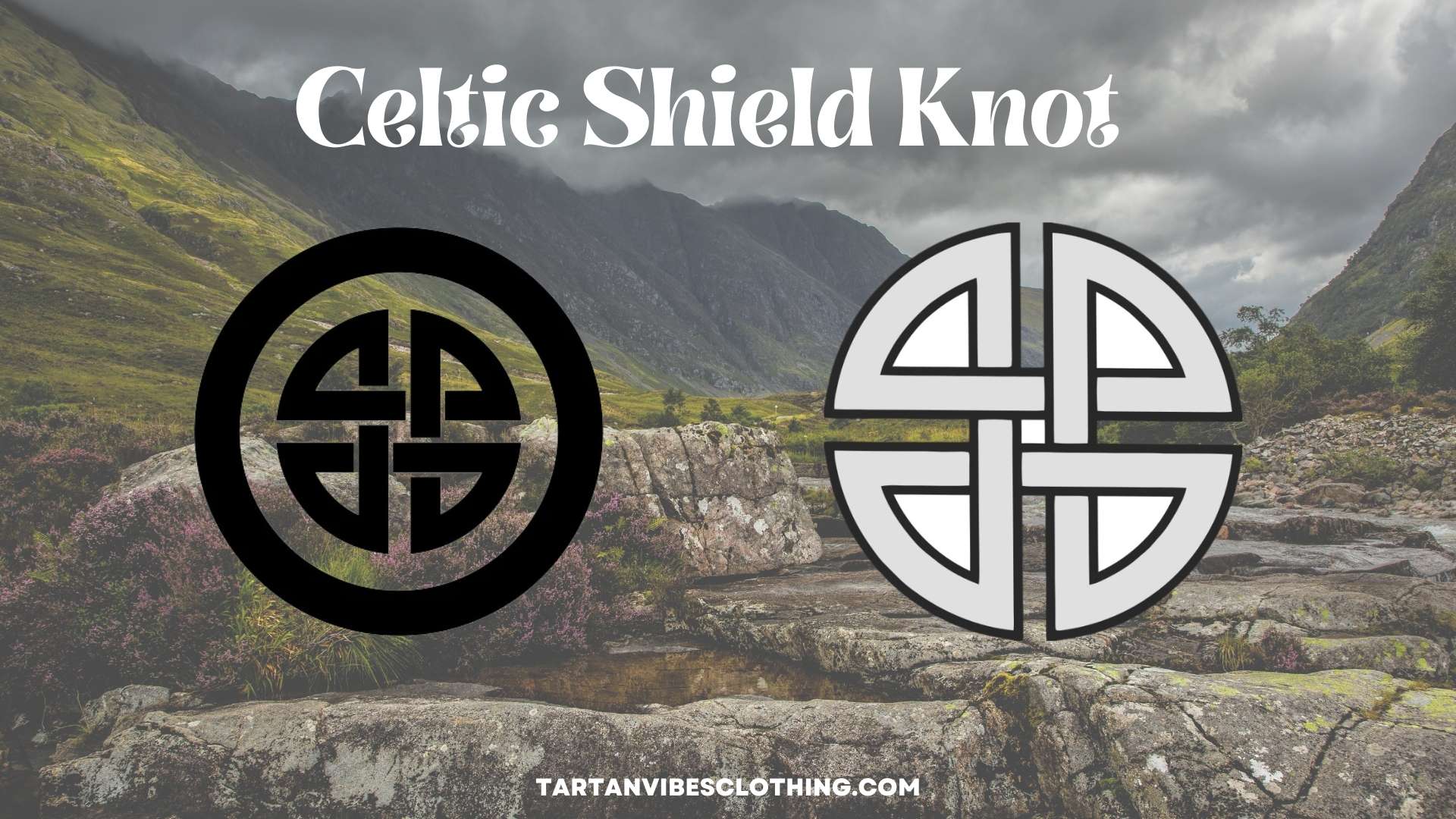
Shield Knot
Meaning: Protection, strength, and security
Origin: Modernly named Celtic-style interlace motif
Scottish connection: Used today in Celtic-inspired Scottish jewelry, tattoos, and decorative designs
The Shield Knot is usually shown as a compact interlaced design with four distinct corners or sections. Today it is widely interpreted as a symbol of protection and strength.
The historical evidence for a specific ancient Celtic symbol formally known as the “Shield Knot” is much less clear than popular explanations sometimes suggest. Interlaced patterns certainly existed in historic Celtic and Insular art, but the modern name and fixed protective meaning should be treated as later symbolic interpretations rather than firmly documented ancient Scottish tradition.
Dara Knot
Meaning: Strength, endurance, wisdom, and resilience
Origin: Modern Celtic-inspired knot associated with the oak tree
Scottish connection: Popular in contemporary Celtic heritage design, but not uniquely Scottish
The Dara Knot is commonly linked with the roots of an oak tree and is now widely used as a symbol of inner strength, endurance, and resilience. The name is generally connected with the Irish word doire, meaning “oak grove,” which also ties this motif more closely to modern Irish Celtic symbolism than to a specifically Scottish historical tradition.
For a Scotland-focused guide, the Dara Knot is still useful because it appears frequently in contemporary Celtic design. It should, however, be presented as a modern Celtic-inspired symbol rather than as a documented ancient Scottish knot with a fixed historical meaning.

Tree of Life
Meaning: Growth, balance, connection, and renewal
Origin: Modern Celtic-inspired tree motif drawing on older reverence for trees
Scottish connection: Common in contemporary Celtic and Scottish heritage artwork
The Celtic Tree of Life usually depicts a tree whose branches and roots form an interlaced circular design. Today it commonly represents growth, balance, ancestry, and the connection between different parts of life.
Trees were important in Celtic culture and mythology. Still, the familiar knotwork “Tree of Life” seen in modern jewelry and artwork should not automatically be treated as a standardized ancient Celtic emblem. The modern design is better understood as a contemporary symbol inspired by older Celtic associations with trees and nature.
Taken together, these knots and spirals show how Scotland’s Celtic visual heritage combines genuine historic interlace and spiral traditions with later symbolic interpretations. That distinction matters: the artwork may be ancient, while some of the meanings attached to it today are much newer.

Ancient Pictish Symbols of Scotland
Pictish Beast
Meaning: Unknown
Origin: Pictish carved-stone tradition
Scottish connection: One of the most distinctive symbols unique to Pictish art
The Pictish Beast is an unusual animal-like figure found repeatedly on Pictish stones. Its curved snout, elongated body, and flipper-like limbs have led to modern nicknames such as the “swimming elephant,” but no identification has been agreed upon.
Examples appear on stones such as the Dyce Symbol Stone and the Princess Stone, often alongside symbols like the Double Disc and Z-Rod. Because its meaning has never been conclusively established, treat interpretations linking it to a specific animal, myth, clan, or deity as theories rather than fact.

Crescent and V-Rod
Meaning: Unknown
Origin: Pictish geometric symbol
Scottish connection: One of the most frequently recurring motifs on Pictish stones
The Crescent and V-Rod combines a crescent-shaped form with a V-shaped rod crossing through it. It appears on numerous Pictish monuments, including stones at Dyce, Dunfallandy, Dingwall, and the Princess Stone.
Its repeated appearance suggests that it carried recognizable meaning within Pictish society, but that meaning has not survived. Scholars have proposed possibilities ranging from personal or family identifiers to social, political, or symbolic markers, yet no single interpretation has been proven.

Double Disc and Z-Rod
Meaning: Unknown
Origin: Pictish geometric symbol
Scottish connection: A common and highly recognizable motif in Pictish stone carving
The Double Disc and Z-Rod features two linked circular forms crossed by an angular Z-shaped rod. Like the Crescent and V-Rod, it appears frequently on Pictish stones and sometimes alongside animals, crosses, and other symbols.
Examples survive at Dyce, Inverurie, Picardy, and the Princess Stone. Historic Environment Scotland describes the Double Disc and Z-Rod as among the most common symbols in Pictish sculpture, while noting that the meaning of the wider symbol system remains debated.

Mirror and Comb
Meaning: Unknown; possibly connected with identity or status
Origin: Pictish object-based symbol
Scottish connection: Appears repeatedly on Pictish symbol stones and cross-slabs
The Mirror and Comb differs from the more abstract Pictish motifs because it depicts recognizable everyday objects. Mirrors, combs, and mirror cases appear on several surviving stones, including the Maiden Stone and other monuments across Scotland.
Their presence has encouraged interpretations involving personal identity, social status, appearance, or gender, but none is certain. The safest interpretation is that the Mirror and Comb formed part of the same visual language as other Pictish symbols, whose original meaning has largely been lost.
Together, these carvings offer one of the clearest visual links to early medieval Scotland. Their mystery is part of their importance: unlike modern Celtic symbols with widely accepted meanings, many Pictish symbols survive without a definitive explanation, making the stones themselves some of the strongest evidence of Pictish culture.

Scottish National Symbols and Their Meanings
Scottish Thistle
Meaning: Resilience, courage, and Scottish pride
Type: National emblem
Scottish connection: One of the most recognizable symbols of Scotland
The Scottish thistle has long been associated with Scotland and is commonly used to represent resilience, toughness, and national pride. Its hardy nature has helped shape the modern symbolism around endurance and determination.
The thistle also appears widely in Scottish badges, crests, monuments, branding, and decorative art. While popular legends connect its rise as a national emblem to an invading army stepping on thistles at night, that story is difficult to verify historically. It is better treated as folklore than fact.

Saltire
Meaning: Scottish identity, heritage, and national pride
Type: National flag
Scottish connection: Scotland’s official national flag
The Saltire, or St Andrew’s Cross, features a white diagonal cross on a blue field and serves as Scotland’s national flag. The Scottish Government identifies the Saltire as Scotland’s national flag.
It takes its name from St Andrew, Scotland’s patron saint. It has become one of the clearest visual expressions of Scottish identity. Today it appears at government buildings, sporting events, cultural celebrations, and throughout Scottish public life.

Lion Rampant
Meaning: Royal authority, courage, and strength
Type: Royal heraldic symbol
Scottish connection: Part of Scotland’s royal heraldic tradition
The Lion Rampant depicts a red lion standing upright on a yellow field within a double border. It is strongly associated with the Royal Arms of Scotland and Scotland’s historic monarchy.
However, the Lion Rampant is not simply an alternative national flag. The Scottish Government describes the Royal Banner of the Royal Arms of Scotland—the Lion Rampant—as His Majesty The King’s official banner in Scotland.
Because of that royal status, it is more accurate to describe the Lion Rampant as a Scottish royal and heraldic symbol rather than an ordinary national emblem.

Unicorn
Meaning: Strength, purity, independence, and nobility
Type: National and royal animal symbol
Scottish connection: Scotland’s national animal and a centuries-old royal emblem
The unicorn is Scotland’s national animal and has been associated with Scottish royalty for centuries. It appears in Scottish heraldry and on the Royal Arms, reflecting its long-standing place in the country’s symbolic tradition.
In medieval symbolism, the unicorn was admired for qualities such as strength and purity. In modern Scottish culture, it is often interpreted more broadly as a symbol of independence, pride, and an untamed spirit.
Together, the thistle, Saltire, Lion Rampant, and unicorn represent a different layer of Scottish symbolism from Celtic knots and Pictish carvings. Their importance comes less from ancient Celtic art and more from national identity, heraldry, monarchy, and later Scottish tradition.

How to Choose and Use Scottish Celtic Symbols Today
For Heritage and Family Identity
For Tattoos

For Jewelry and Gifts

For Personal Meaning
Think first about the message: protection, strength, family, faith, growth, or Scottish identity. Choose the symbol whose history and modern meaning best fit what you want it to represent.
Conclusion


Scotland’s symbolic heritage blends shared Celtic traditions, distinctive Pictish imagery, and national Scottish emblems. Celtic knots, the Triquetra, and the Triskelion belong to a wider Celtic visual tradition, while symbols such as the thistle, Saltire, Lion Rampant, unicorn, and Pictish carvings tell more specifically Scottish stories.
The most meaningful symbol is not simply the most famous one, but the one whose history, cultural context, and modern meaning best match what you want it to represent.
FAQs About Celtic Symbols of Scotland
Do Scottish Clans Have Their Own Celtic Symbols?
Not usually. Scottish clans are more commonly identified by clan crests, badges, tartans, mottos, and heraldic traditions than by a unique Celtic knot or ancient symbol assigned to each clan. You can add Celtic motifs to modern clan-inspired designs. Still, they should not automatically be treated as historical clan emblems.
What Is the Difference Between a Clan Crest and a Celtic Symbol?
A clan crest comes from Scottish heraldic tradition and is associated with a particular clan chief or clan identity. A Celtic symbol, such as a knot or Triskelion, belongs to a broader artistic or symbolic tradition and generally isn't tied to a single Scottish surname or clan.
Are Celtic Symbols Religious?
Some are, but not all. The Celtic Cross and some uses of the Triquetra have strong Christian associations, while knots, spirals, and other motifs may be decorative or carry modern symbolic meanings such as continuity, connection, or growth. Their meaning depends on the design and historical context.
Is There a Scottish Celtic Symbol for Good Luck?
No single historically established Scottish Celtic symbol universally means “good luck.” Today, people may choose symbols such as the thistle for resilience and Scottish identity or Celtic knotwork for ideas like continuity and connection, but they should not present these as ancient symbols of luck without evidence.
Can Celtic, Pictish, and Scottish Symbols Be Used Together?
Yes, especially in modern artwork, jewelry, tattoos, or heritage-inspired designs. The key is to understand that they come from different historical traditions. Combining them can create a meaningful Scottish-inspired design, as long as you don't present Celtic, Pictish, and national symbols as having the same origin.

Teresa Finn
As someone with a deep passion for clan heritage, especially the intriguing world of tartans and their rich traditions, I'm here to be your companion on this exciting journey. Together, we'll delve into the depths of clan history, uncovering the stories behind these vibrant tartans and making every connection to your heritage more meaningful.


